

“I’m not someone who chases numbers. I’m someone who creates opportunities.” — Karishmaa Singhal
Most companies spend six to seven figures a year on ads, influencer partnerships and employer-branding campaigns to look credible to the outside world. And the entire time, sitting inside their own building, on their own payroll, is something that works better than all of it combined: their people.
Nobody had built a structured way to unlock that. Karishmaa Singhal did.
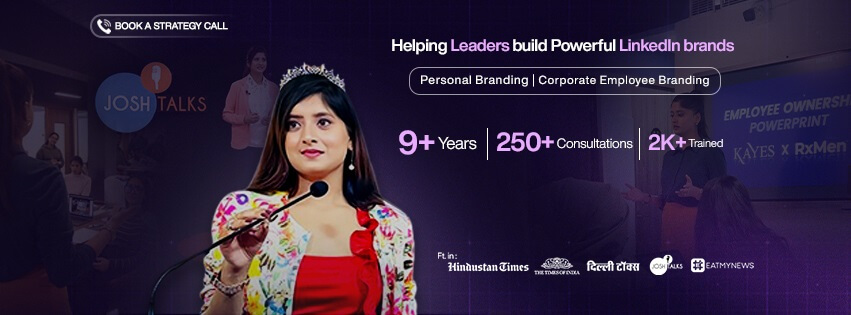
Here we are talking about Karishmaa Singhal, a Delhi-based LinkedIn personal branding and corporate employee branding expert, the founder of Kaymarc, and the creator of the Employee Ownership Powerprint (EOP) — an offline, in-person programme built to turn the employees of large organisations into their company’s most credible marketing asset. Where most brands chase visibility through ads and influencers, Singhal built a system that unlocks the reach already sitting inside a company: its own people.
| 250+
Clients Across 8 Countries |
2,000+
People Trained |
2
Published Books |
5M+
Reach Generated via LinkedIn |
Early Life & Background
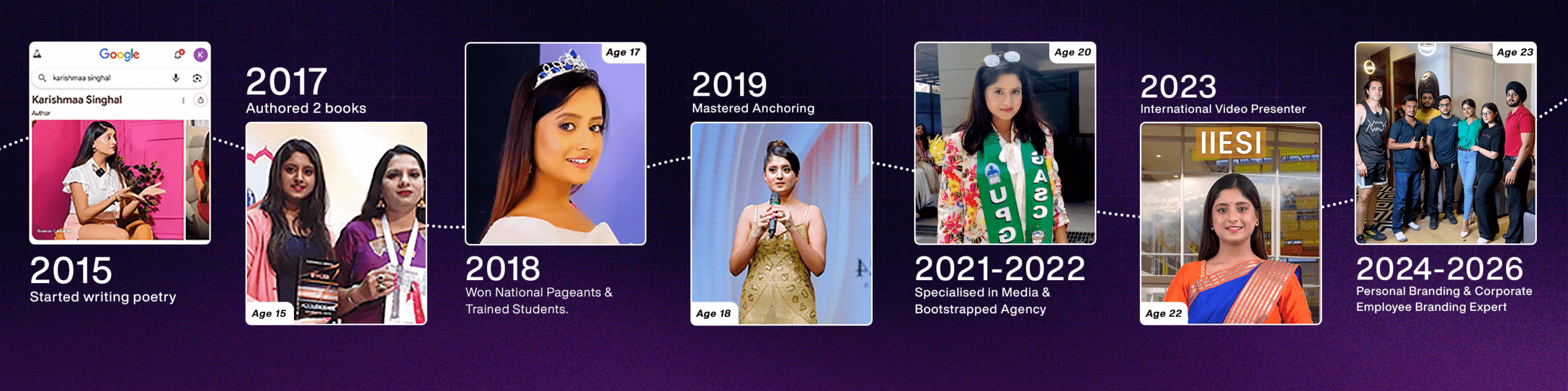
Singhal was born and raised in Delhi. She has spoken openly about struggling academically in school — she failed every pre-board exam in Class 10, and came close to not receiving her admit card for her board exams. She sat them anyway and scored above 90%. Even so, she felt certain that two more years buried in books wasn’t the right use of her time.
Around 15, at one of the lowest points in her confidence, her mother encouraged her to explore what interested her alongside her studies. That permission changed everything. Singhal entered modelling, and over three months lost close to 30–40 kilograms as part of her preparation — a transformation she describes as far more than physical. It changed how she carried herself and how she saw herself, and it planted an early interest in helping other women access the same confidence and grooming resources she’d had to fight for.
She trained for modelling & pageantry at 16 and went on to compete in multiple pageants — an experience she has called “where I discovered myself,” not simply her introduction to the industry. Around the same time, she became known as one of the youngest published authors in her school, and was recognised for her communication skills. A mock pageant that needed a last-minute host became her introduction to anchoring; she was years later picked for a live seven-hour sports broadcast as a first-time anchor, an unusual bet for a production team to make on someone new. A personal monologue she’d recorded for herself, seen by the right person, opened the door to acting.
She studied Mass Media and Communication, specialising in Advertising, at Usha Pravin Gandhi College of Arts, Commerce and Science in Mumbai — training that gave her an early, practical grip on persuasion and storytelling long before she built a brand strategy for a client. The move from Delhi to Mumbai for college coincided almost exactly with the pandemic, which kept her largely in Delhi for her first two years regardless. She was rarely in class during this period, building her business and pitching clients instead of submitting coursework, and eventually failed a semester on attendance rather than academics. Years later, she returned to the same institution as a guest lecturer, invited to teach LinkedIn strategy.
OUR RECOMMENDATIONS
Career Journey
The pandemic disrupted modelling and physical shoots, and with them, the only career path Singhal had been building toward. Around this time she came across a ₹99 webinar by Avi Arya’s Video Sales Mastery workshop — a person she still considers a mentor despite never having met him — and it introduced her to digital marketing as a real discipline rather than a hobby.
Her first practical marketing experiment came soon after. A young tarot-card reader asked her to help produce and launch a Law of Attraction workshop. With a ₹150 ticket price, a Canva creative, Instagram promotion, a video Singhal edited herself on InShot, and a Google Form to collect signups, the two of them — both under 19 at the time — generated close to ₹20,000 in sales within four days. It was a small number in absolute terms and a turning point in every other sense: Singhal realised she could create communication that moved people to act.
She expanded into F&B marketing next, then turned her attention to her mother’s numerology practice, applying everything she’d taught herself about copywriting, outreach and organic influencer marketing. That campaign generated roughly ₹60,000 in a single month and brought in some of the country’s most recognisable names in entertainment as participants.
There was no agency structure in the beginning — just Singhal coordinating with freelance designers, learning terms like “brand strategy” and “deck” on the job, and building what she then called “examples” and would later call case studies. Around the same period, still a teenager, she was giving talks at 15-plus institutions across Delhi University and IP University and serving as a spokesperson for Organ for Life. Her first paying client, at ₹3,500, came through that network.
She registered her first company as Kayes Dream Projject — the name drawn from an Arabic word meaning firm, hard, fearless, a trait she’d set out as a childhood ambition for herself — and built it around Diamond, Gold and Silver service packages. The lesson that followed was a hard one: a model that worked for clients could still be unsustainable for the business running it. Singhal shut the agency down and rebuilt it more than once, changing cities, team structure and client selection along the way, before landing her first major international client around the seventh or eighth month — a relationship that continues today.
What followed was a gradual shift from accumulating clients to building proof: fewer, better-aligned engagements, stronger case studies, and eventually the business now known as Kaymarc, founded in its current form in 2021.
Current Work & Expertise
Today, Singhal is the founder of Kaymarc, a boutique, high-ticket LinkedIn personal branding and corporate employee branding studio niched to Healthcare, SaaS, Tech and Finance rather than taking on volume clients across every industry.
She operates as a LinkedIn growth strategist, a corporate communication trainer for mid-level and senior leaders, a career coach, and a YouTube educator. Her flagship educational property is the LinkedIn Content Masterclass, a growing video series breaking down profile optimisation, content strategy, engagement and outreach — built from the same operating system she runs inside Kaymarc itself.
How to Use LinkedIn Services Section to Get Clients (Full Guide)
Building the Employee Ownership Powerprint
Years of building personal brands for founders and professionals led Singhal to a larger observation: individuals increasingly shape how the organisations around them are perceived, yet companies were spending heavily on ads and influencer partnerships to build external visibility while an equally credible, far efficient channel — their own employees — went almost entirely untapped.
The Employee Ownership Powerprint is her answer to that gap: an offline, in-person, cohort-based corporate programme designed to train company’s employees to build personal brands that make the whole organisation more visible & more trusted.
“Employee branding is not about turning employees into influencers,” Singhal says of the programme. “It is about helping employees become recognisable for their expertise while becoming stronger representatives of the organisation they belong to.”
Her goal for EOP is direct: make it synonymous with her name, and establish Corporate Employee Branding as a recognised, repeatable part of how modern companies build their brand.
Achievements & Results
Among her results: the CEO of a media industry publication saw LinkedIn post impressions grow from 1,443 to 26,239, profile views climb from 264 to 422, and engagement jump from 1 to 488 — a 12,622% increase in visibility within 60 days. She has also worked with a healthcare brand that has since scaled its presence to more than 11 countries.
Her speaking history includes Josh Talks and more than 15 engagements at Delhi University and IP University institutions,Mumbai University, Christ University, G.D Goenka group of schools and she has been featured in national publications including Hindustan Times and The Times of India, alongside regional media.
Philosophy & Insights
“I’m not someone who chases numbers. I’m someone who creates opportunities,” is the line Singhal returns to most. She believes chasing revenue or vanity metrics too early distracts a founder from building the underlying product and positioning that create sustainable growth — and that when a project is genuinely driven by passion, commercial results tend to follow on their own.
Starting businesses young repeatedly exposed her to questions about credibility. She’s been told she was too inexperienced to handle large projects, charge certain fees, or manage professionals older than herself. Her response settled over time into something simpler than an argument: “This isn’t about my age. It’s about how I can add value.” Case studies, outcomes and continuous upskilling, she says, matter more than years logged. “When your work speaks for you, age doesn’t matter.”
Her leadership philosophy starts with people skills, followed by upskilling, followed by selling — “you sit at the ground level, yet stay at the top.” And she rejects the conventional framing of work-life balance outright: “I don’t believe in work-life balance, because your work is life.” For someone building something out of genuine passion, she argues, work naturally becomes part of life rather than something to be defended against it.
On video and content, three convictions guide everything she teaches: make filming part of daily life rather than treating it as a special task; let go of perfectionism, because “people connect with imperfect things”; and start with what you actually want to talk about before you study competitors or chase a niche. “Execution is the key.”
Impact & Contribution
Beyond client work, Singhal runs LinkedIn Lobby, an in-person workshop and networking initiative built on the idea that LinkedIn growth doesn’t have to be a solo, screen-only pursuit. Through its “Cappuccino Networking” events, she brings professionals together offline to build the same relationships they’re chasing online — paired with her YouTube masterclass, it gives her a two-sided education engine: one built for reach, one built for depth.
Long before either existed, a teenage Singhal had already sketched a version of the same instinct: an affordable personality-development programme for women, built around the idea that “personality enhancement now costs you less than a pizza.” The specifics have changed since then. The underlying belief — that confidence and communication shouldn’t be gated behind cost — hasn’t.
Personal Side
Off the clock, Singhal keeps her mornings slow — a cup of bulletproof coffee, no rush into the day. She unwinds to the sound of handpan music, has practised gratitude and meditated daily for six years, and describes herself as someone who genuinely loves collaborating with people rather than working around them. She has a real passion for fashion, and feels that the stage, a microphone and a camera are her three best friends. Teaching and training, she says, isn’t a duty that comes with the job — it’s the part of the job she loves most.
Karishmaa’s Golden Leanings by 24
- Don’t wait until you feel ready. Start, learn and improve through execution.
- Build proof before you chase recognition. Strong work and real case studies create credibility that titles can’t.
- Become known for something valuable instead of trying to be known by everyone.
- Pay attention to the problems people haven’t learned to articulate yet — that’s usually where the opportunity is sitting.
- Develop people skills before anything else. Leadership and business are ultimately built through people.
- Upskill continuously. Age should never become an excuse to stop learning.
- Learn to sell. A good idea that can’t be communicated and sold stays an idea.
- Chase passion, not money — it’s the only thing that survives the slow years.
Closing Statement
Karishmaa Singhal didn’t wait for the market to tell her what corporate branding should look like. She looked at what every company already had and nobody was using, and built the programme to unlock it. Through Kaymarc and the Employee Ownership Powerprint, she continues to prove that the strongest marketing channel a company will ever have isn’t an ad account. It’s the people.
Follow her on Social Media
https://www.linkedin.com/in/karishmaasinghalmarketing/
https://www.youtube.com/@karishmaasinghalcreates
https://www.instagram.com/thekarishmaasinghal/
https://www.instagram.com/kaymarc.marketing/
https://canva.link/s15a266tjyn00jq