

Cubish Review: Building the Spatial Web One Cube at a Time
The internet, as we know it, is largely flat.
Websites, social platforms, and search engines operate in a borderless digital space — accessible from anywhere, but rarely connected to the physical places around us.
Scroll through Instagram in New York, Milan, or London, and the underlying platforms remain largely the same.
Open Google in Los Angeles, Rome, or Singapore, and you’re still navigating the same globalized web.
But what if every physical location on Earth had its own persistent digital layer?
A world where memories, businesses, information, and experiences are anchored not to feeds or screens, but to the exact real-world coordinates where they belong.
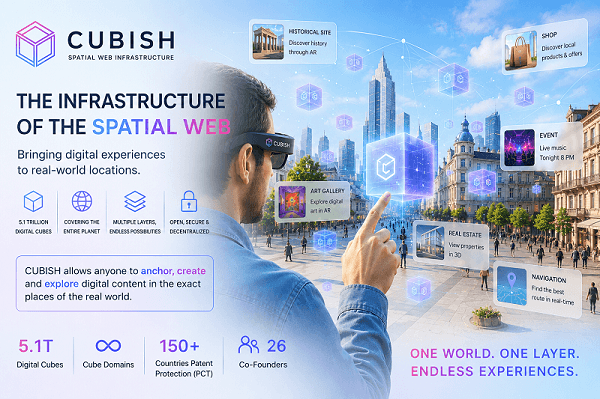
That’s the future Cubish is betting on — a Spatial Web that seamlessly blends the digital and physical worlds, transforming places into living layers of interactive information.
Cubish is betting that this is the next evolution of the internet — a Spatial Web that blends the digital and physical worlds seamlessly.
What is Cubish?
In simple terms, Cubish is a Spatial Web platform that divides the Earth’s surface into over 5.1 trillion geolocated “cubes” (each roughly 10m × 10m).
Cubish proposes something structurally different: a multi-layered, multi-tenant model where thousands of independent Cube Domains can coexist within the same physical cube without interfering with one another.
Each domain is separately managed, separately discoverable, and separately customizable. The analogy to the web is deliberate — just as thousands of websites can exist at the same IP address, thousands of Cube Domains can exist within the same 10×10 meter square of Earth.
Users can create Cube Domains — digital spaces linked to these physical locations — where they upload and manage content like videos, images, audio, documents, text, and more.
It’s not just another mapping tool or social app.
It’s an attempt to create a structured, layered digital ecosystem over reality itself.
Content is discovered based on proximity and location rather than algorithms or keywords.
Today it’s primarily web and mobile; tomorrow, it envisions deep AR/VR/XR integration, turning the physical world into an interactive, intelligent interface.
OUR RECOMMENDATIONS

Team & Company Background
Dorian Lazzari, CEO and visionary founder, has driven this project with a team of 26 co-founders, emphasizing infrastructure over hype.
Dorian Lazzari is based in Reggio Emilia, Italy. His background is not that of a typical Silicon Valley-style founder.
He is quiet, methodical, and deeply strategic — a self-described lifelong devotee of immersive technology who has been thinking about the intersection of physical space and digital content for most of his adult life.
Dorian Lazzari brings passion for immersive tech and a high-conviction, infrastructure-first mindset. He has navigated earlier experiences to focus on this long-term vision.
The company, Cubish S.r.l. (innovative startup based in Naples, Italy), features 26 co-founders and has built the core over four years without major drama. Patent-pending protection adds credibility. No major external funding announced yet; it emphasizes strategic partnerships.
The team size and distributed Italian roots reflect a dedicated, founder-driven effort.
Core Concept & Innovation (How Cubish Actually Works)
The core innovation is the cube-based geospatial architecture.
Unlike Google Maps (which overlays information on a 2D/3D view) or traditional social platforms (feed-based and location-agnostic), Cubish creates a persistent, ownable digital layer tied to precise real-world spots. Multiple Cube Domains can coexist in the same cube, layered by relevance, quality, and interaction through a merit-based system.
Cube Domains act like geolocated websites or digital identities. Free versions get you started; Pro versions allow custom names and expansions across distant cubes, letting a domain span multiple physical sites (e.g., a brand’s stores worldwide).
Is it genuinely innovative? Yes. The structured 5.1 trillion-cube infrastructure and layered ownership model feel fresh in the Spatial Web space. It’s futuristic in ambition but practical in starting with simple content attachment today.
Can it become mainstream? It has strong potential if AR/smart glasses adoption accelerates, but it requires significant network effects and user education.
Key technical properties of the system include:
Multi-Layer Architecture — Unlike single-layer AR systems, Cubish enables thousands of independent content layers to coexist in the same physical space. A government institution’s public service information, a local restaurant’s menu and promotions, and an artist’s digital gallery can all exist within the same 10×10 meter cube without overlapping.
Cube Domain Expansion — Domains are not permanently fixed to their origin cube. Users can expand their domain’s presence to other cubes anywhere on Earth, allowing content to follow geographic narratives or be distributed across multiple relevant locations.
Merit-Based Content Ranking — The platform’s long-term roadmap includes an algorithmic system to prioritize content quality over virality, similar in philosophy to how search engines rank web domains. This is a direct counter to the engagement-optimized feed models of conventional social media.
Future-Ready Architecture — Every design decision in Cubish was made with future AR and VR integration in mind. The platform is explicitly designed to become the backbone of an immersive Spatial Web — not merely a location-tagging tool.
The platform is currently available as a free application on both the Apple App Store and Google Play Store, with web access at cubish.com.
The Business Vision — Where the Money Is
Cubish is not simply a social experiment. It is a business, and its commercial model reflects an unusually sophisticated understanding of where value accumulates in platform economies.
The near-term opportunity is in proximity marketing and local business engagement. Brick-and-mortar businesses — restaurants, museums, retail stores, hotels, gyms — can attach contextually relevant digital content to their physical spaces: menus, promotions, loyalty programs, digital catalogs, event announcements. This is fundamentally more powerful than a Google Business listing because it is spatial, layered, and interactive.
The medium-term opportunity is in institutional and civic adoption. Municipalities, universities, libraries, and cultural organizations can use Cube Domains to create contextualized digital experiences for citizens and visitors. A city council can attach public service information to civic spaces. A university can create location-specific course materials tied to physical campus buildings. A national park can anchor naturalist content to specific trails and geological features.
The long-term opportunity — and this is where the Cubish vision becomes genuinely audacious — is in Spatial Web infrastructure. As smart glasses, AR headsets, and ambient computing devices become mainstream consumer products, the demand for a structured, reliable, multi-layered spatial content infrastructure will be enormous. Cubish is positioning itself to be that infrastructure — the “spatial internet” layer that AR hardware manufacturers and app developers build upon.
The planned Cube Domain Marketplace is perhaps the most commercially significant element of the roadmap. If Cube Domains acquire genuine utility and cultural value, the ability to buy, sell, and transfer prime-location domains — think the digital equivalent of prime real estate — could become a significant revenue engine.
The Market Opportunity — Timing and Scale
The Spatial Web is not a hypothetical future technology. It is an emerging category with real momentum, real investment, and real adoption pressure.
The convergence of several macro trends creates the conditions for a platform like Cubish to thrive:
Smart Glasses Proliferation — Meta’s Ray-Ban Smart Glasses have demonstrated genuine mainstream traction. Apple’s Vision Pro, though expensive, has established the category. In 2025-2030, smart glasses are expected to follow the adoption curve of smartphones. When they do, the demand for location-anchored digital content will explode — and there is currently no dominant infrastructure for it.
The Decline of the Generic Feed — Consumer frustration with algorithmic, context-free social media is well-documented. Cubish’s geography-first, intent-based model offers a compelling alternative that connects digital content to the places and moments where it matters.
Tourism and Local Discovery — The global tourism industry spends hundreds of billions annually on visitor experience and local marketing. Cubish’s model maps almost perfectly to this use case: travelers walking through a city who can access layered, location-specific content from every building, landmark, and neighborhood they encounter.
Smart Cities and Digital Government — Urban technology investment is accelerating globally. Municipalities are increasingly interested in tools that allow them to communicate with citizens in contextually relevant, spatially organized ways.
For a startup with a pending global patent, an early-mover position, and a clear architectural advantage over single-layer competitors, the timing is defensible.
User Experience (UX/UI)
The platform has a modern, clean interface with a startup polish. The mobile app (available on Google Play and App Store) lets users create domains, upload media, and discover nearby content within ~30 meters. The Explorer tool supports searching and interacting across the web and app.
Onboarding introduces the spatial concept clearly, though the idea may still feel novel for non-tech users. Navigation is straightforward for location-based tasks, with good responsiveness for an early platform. It feels beginner-accessible for basic use (creating a domain and adding content) but reveals more depth as you explore expansions and layering.
It has a contemporary UI without feeling overly gimmicky, though it retains some early-stage experimental vibes. Overall, quite approachable.
Features & Functionality
Key capabilities include:
- Creating and customizing Cube Domains.
- Uploading multimedia content.
- Proximity-based discovery (nearby content on the home feed).
- Explorer for global search and management.
- Domain expansions for multi-location presence.
- Layered content in the same physical space.
Performance appears stable for current scale, with content management feeling intuitive. The system supports both personal and professional use cases, with future immersive features planned. It’s functional and expanding, though still maturing.
Real-World Use Cases
Cubish has broad applicability:
- Tourism & Heritage: Attach stories, media, or AR previews to landmarks and museums.
- Real Estate: Virtual property tours and location-specific info.
- Retail & Local Business: Hyperlocal marketing, offers, and discovery.
- Education: Interactive field learning tied to physical sites.
- Events: Geolocated experiences and networking.
- Smart Cities: Layered urban data and services.
- Gaming & Social: Location-rooted interactions.
Tourism, retail, real estate, and cultural institutions are likely early adopters. Businesses could use it as a digital presence layer complementing (or competing with) traditional websites and maps.
Future Potential — What Cubish Could Become
If Cubish executes — if it solves the cold start problem, if it deploys its merit ranking system, if it builds the marketplace, if smart glasses go mainstream, if the patent holds — what does it look like?
At scale, Cubish could function as the domain registration system of the physical world. Just as every website has a URL that identifies it on the internet, every meaningful physical location could have a Cube Domain that identifies it in the Spatial Web. Organizations, businesses, and individuals would register and manage their spatial presence on Cubish the way they currently manage their web presence.
The implications extend across virtually every sector:
In retail, every store becomes a multi-layered digital experience — browsable before you enter, expandable after you leave, connectable to loyalty programs and real-time inventory.
In education, every university building, laboratory, and outdoor space becomes a living knowledge repository — a field trip to a geological formation can be paired with real-time scientific content attached to the physical rock face.
In cultural heritage, every monument, artwork, and historic district can host layers of contextual information — authored by institutions, curators, citizens, and travelers — creating a living, evolving record of human history attached to its physical origins.
In emergency services and civic infrastructure, every physical space can carry emergency procedures, accessibility information, and real-time public safety updates — without requiring citizens to know where to search.
And in the long arc of immersive technology, when AR glasses become as ordinary as smartphones, Cubish could be the operating system of physical space — the invisible layer that makes every square meter of the planet digitally legible.
Strengths
- Truly unique geospatial concept and architecture.
- Ambitious yet grounded vision under Dorian Lazzari’s leadership.
- Patent-pending technology (filed 2025, extended internationally).
- Strong scalability ambitions with 26 co-founders showing resilience.
- First-mover positioning in structured Spatial Web.
- Community and merit-based layering potential.
- Excellent alignment with AI + AR/XR trends.
Concerns
- Extremely early-stage (founded 2025, limited current adoption).
- Heavy reliance on network effects and user education.
- Monetization (Pro domains, etc.) is developing.
- Competition from tech giants with vast resources.
- Privacy, moderation, and scalability challenges at planetary scale.
- Depends on broader AR/smart glasses ecosystem growth.
- Concept may feel abstract to average users initially.
An Early Bet Worth Watching
Cubish is not a finished product. It is an infrastructure bet — a long-term wager on how humans will relate to digital information as computing moves from screens to space.
Dorian Lazzari is, by every available account, the kind of founder capable of making that bet pay off: patient, intellectually rigorous, capable of sustaining team belief across four years of silence, and deeply committed to building the right architecture before chasing adoption. The work-for-equity model with 26 co-founders is not a conventional path — it is a statement of values, and it has held.
The technology is novel. The patent position is serious. The timing — with smart glasses approaching mainstream viability — is better than it might appear.
Cubish is building something that, if the Spatial Web becomes what its proponents believe it will, will have been indispensable from the start.
Founder’s Vision: Q&A with Dorian Lazzari
1. Can you tell us about your background and what inspired your entrepreneurial journey?
More than ten years ago, I became fascinated by one technology in particular: augmented reality. The idea that you can see a digital element perfectly integrated into the physical environment, even though it does not actually exist, felt to me like the closest thing to magic.
Over the years, I studied and explored all the technologies connected to this field. At a certain point, I realized that one fundamental piece was missing: an infrastructure capable of organizing digital content in the real world, much like the Internet organized information on computers.
What was needed was an open and structured system that would allow multiple digital dimensions to coexist in the same physical spaces without interfering with one another. This realization led to the creation of Cubish, which today represents the initial framework of what I hope will become a much larger and more transformative platform.
2. What motivated you to start Cubish, and what problem were you aiming to solve?
As mentioned above, my goal was to bring data and immersive technologies into the real world through an open and structured system, similar to what the Internet has represented over the past decades.
Cubish was created to provide an infrastructure that allows anyone to anchor digital content to physical locations, making it accessible, organized, and scalable.
3. What were some of the biggest challenges you faced while building the company?
The greatest challenge was building the team.
I needed people who would do more than simply work on Cubish. I needed people who truly believed in the vision and were willing to put their heart into it. Cubish is a highly ambitious and technically complex project that requires an extraordinary level of commitment.
Through LinkedIn, I searched for every key role needed for the project, reaching out to hundreds of professionals for each position and offering a work-for-equity collaboration. It was an extremely demanding process, and 99% of the people said no. But I only needed one person to say yes.
Within a few months, we built a team of 26 co-founders and structured two companies with dedicated areas covering technology, communication, strategy, and legal matters.
We also designed a two-tier corporate governance structure with voting shares and an equity pool that elects its own representative to the Board of Directors. This model gives a voice to everyone who has invested time and expertise in the project, creating a balanced and democratic organization.
It was one of the most complex and meaningful organizational achievements of my journey.
4. Is there a particular achievement or milestone you are especially proud of?
The team.
Beyond the project itself, the team always comes first. There are no compromises on this point. The team is the heart and the engine behind everything.
Thanks to the work, professionalism, and commitment of everyone who believed in this vision, Cubish evolved from an idea into a project, and from a project into a company.
We still have a long journey ahead, and I want to continue it with the people who had the courage to say yes to this enormous challenge.
5. What is your long-term vision for Cubish and the industry you operate in?
Cubish aims to become a foundational infrastructure for the Spatial Web.
The goal is to enable anyone, anywhere, to build digital and immersive experiences in the real world without preventing others from doing the same in the exact same locations.
The platform is based on a system of 5.1 trillion cubes that function like miniature search engines. Within each cube, users can create potentially unlimited Cube Domains and expand them across multiple cubes anywhere on Earth. This structure forms the framework for building an ecosystem of immersive digital dimensions integrated with the physical world.
In March 2026, Cubish’s patent was extended through the World Intellectual Property Organization PCT process to more than 150 countries. The protection covers not only the core concepts of cubes, domains, and content, but also technologies designed to interact with smart glasses and immersive headsets.
We are still at the very beginning.
6. How do you see AI and emerging technologies shaping the future of your business or industry?
They will play a fundamental role.
I follow the evolution of emerging technologies every day because I believe it is essential to maintain a clear and up-to-date view of what is happening in order to make the best strategic decisions for Cubish.
Artificial Intelligence will have a significant impact on many aspects of the platform. At the same time, technologies such as Visual Positioning Systems (VPS) developed by Niantic and Google may play an important role in enabling immersive experiences.
That said, I also believe entirely new and alternative approaches may emerge.
7. What advice would you give to aspiring entrepreneurs and founders?
It is far more difficult than you can imagine, but it can also deliver rewards beyond anything you expect.
8. Beyond business, what personal values or principles guide your leadership style?
I am extremely determined, and it is very difficult to discourage me.
Even when people or circumstances manage to knock me down, I get back on my feet quickly and keep moving forward. I have received countless rejections, and many people told me that what I was trying to build was impossible.
Instead of stopping me, those rejections gave me even more energy.
I will continue to push forward and tackle problems by exploring different approaches, because I believe there is always a solution. The challenge is having the patience and determination to find it.
Final Verdict
Cubish is a bold, visionary project worth following for anyone interested in the future of technology, location-based experiences, or spatial computing. Early adopters — creators, businesses, tourism operators, educators, and tech enthusiasts — should try it to claim spaces and experiment.
Ratings (out of 10):
- Innovation: 9/10 (Genuinely fresh architecture)
- User Experience: 8/10 (Clean and promising, with room to mature)
- Practicality: 7/10 (Strong concepts, adoption curve ahead)
- Future Potential: 9/10 (Well-positioned for spatial/AI/AR future)
- Overall: Promising infrastructure play with high upside.
Cubish may not just be building another platform — it’s attempting to redesign how humanity interacts with digital information in physical space. Under Dorian Lazzari’s leadership, it’s a project to watch closely as the Spatial Web era unfolds.
Empower your reality. Worth exploring today for its long-term vision.