
“Most organizations don’t have a training problem. They have a performance problem.”
That belief captures the professional journey of Pooja Dangol, a Learning and Development Consultant, Corporate Trainer, HR Consultant, Keynote Speaker, and the driving force behind PS Learning Lounge.
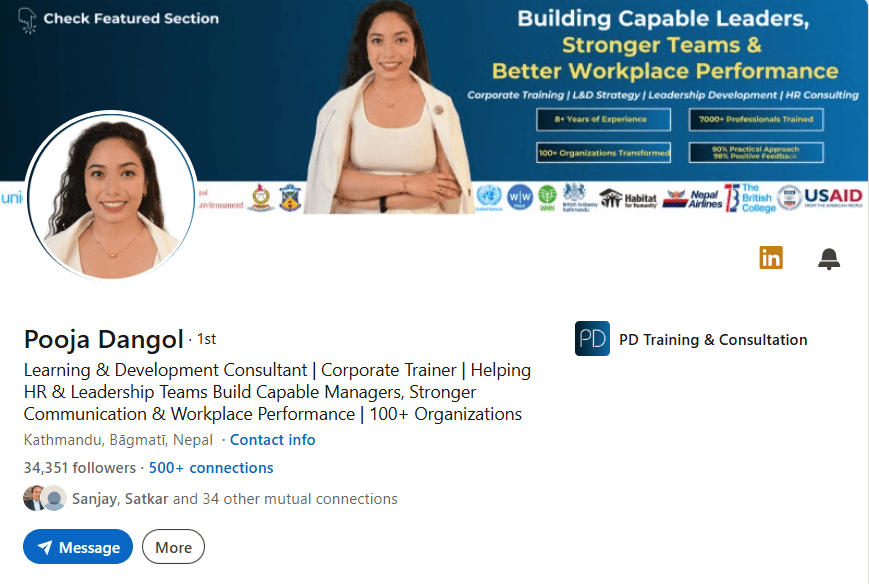
Over more than eight years, Pooja has worked at the intersection of people, leadership, learning, and organizational performance. Her work has reached more than 7,000 professionals across over 100 organizations in sectors ranging from banking, education, government, and development to hospitality, healthcare, technology, manufacturing, and services.
Her experience has also expanded across professional contexts connected with the United States, the United Kingdom, Germany, Japan, India, and Nepal. Today, PS Learning Lounge operates through offices in Nepal and India.
Yet the most important part of Pooja’s story is not the number of organizations she has worked with or the number of people she has trained. It is the question that has followed her through every stage of her career:
What actually helps people perform better at work?
She has seen technically capable employees promoted into management without being prepared to lead people. She has seen teams struggle not because they lacked talent, but because communication broke down. She has seen organizations invest in workshops while the systems around employees remained unchanged. And she has seen how meaningful development happens when learning, leadership, structure, and support work together.
That is why Pooja does not see training as an event. She sees it as one part of a much larger process of building capability.
OUR RECOMMENDATIONS
A Foundation in Management and Human Development
Based in Kathmandu, Nepal, Pooja built her professional foundation through a combination of management education and specialized study in learning and development.
She completed a Master of Business Administration, followed by a Master’s in Training and Development. She also completed a Diploma in STEAM Education and Teaching, Training and Developing Professionals through Training Qualifications UK.
The value of this education was not simply the qualifications themselves. It gave Pooja a way to connect questions organizations often treat separately: how adults learn, how performance is shaped, why knowledge does not always become consistent behavior, and why technically strong professionals can struggle when they become managers.
Those questions became more important as her career moved from study into real organizations.
The Early Years: Learning That the Environment Matters
Some of the most formative experiences in Pooja’s career came through work involving employability and workplace inclusion for persons with disabilities.
As a Project Manager with CBM International and later Blind Youth Association Nepal, she worked on training needs assessment, employability development, career readiness, accessible learning, employer sensitization, workplace integration, and post-placement support.
The work required more than preparing people to enter the workforce. It also meant working with employers and stakeholders on inclusive hiring, accessibility, and successful integration.
The experience taught her an important lesson: a capable person can still struggle inside an environment that is not prepared to support that capability.
Sometimes the individual needs development; sometimes the system needs to change.
That distinction would later shape her approach to HR consulting, leadership development, and organizational capacity-building.
During the same broad period, she also worked in HR consulting and training assignments with organizations including Himalayan General Insurance and Big Mart. Her responsibilities included Training Needs Assessment, training strategy, annual planning, development of learning materials, program delivery, monitoring, and evaluation.
Her work with the Inland Revenue Department took that experience into a public-sector setting, where she reviewed existing training systems, conducted gap analysis, and contributed to capacity-building strategies and monitoring frameworks.
These early assignments gradually shaped one of the strongest principles in her professional approach:
Diagnose before you design.
An organization may ask for a communication workshop when the real issue is unclear responsibility. It may request motivation training when employees are struggling with weak systems or inconsistent leadership. It may ask for leadership development when managers have never been given clear expectations about what leadership actually requires.
For Pooja, the quality of a solution depends on the quality of the diagnosis that comes before it.
From Practitioner to Entrepreneur
By 2021, Pooja’s experience had already crossed several professional boundaries. She had worked in HR consulting, development projects, inclusive employment, project management, organizational capacity-building, training design, and facilitation.
The next turning point was entrepreneurship.
What began as her own professional practice gradually evolved into the wider platform now known as PS Learning Lounge.
The shift was significant because Pooja was no longer only being asked to deliver training sessions. Organizations increasingly involved her in the work before and after the training room: identifying capability gaps, designing curricula, developing managers, measuring performance, and creating systems that help learning continue.
These questions moved her work from individual events toward organizational capability.
Today, PS Learning Lounge brings together corporate training, Learning and Development strategy, leadership development, HR consulting, organizational development, curriculum design, executive facilitation, research, assessment, customer service excellence, and long-term capability-building.
With operating offices in Nepal and India, the platform combines experience from both markets. Its work has also expanded into international professional contexts connected with the United States, the United Kingdom, Germany, Japan, and other countries, strengthening Pooja’s ability to work across different workplace cultures and expectations.
A Career Across Very Different Rooms
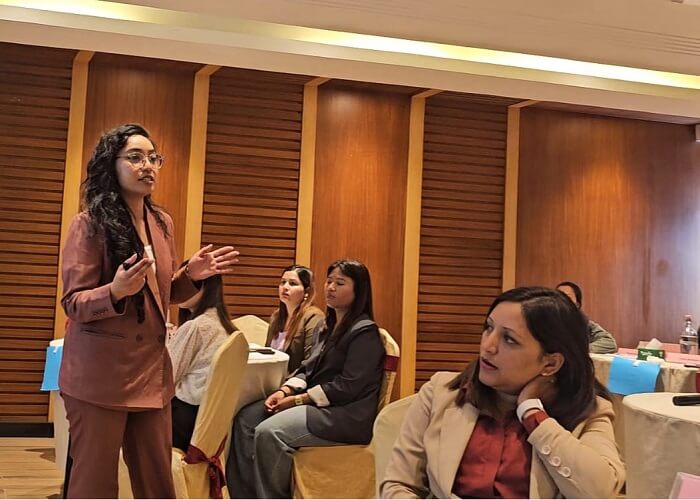
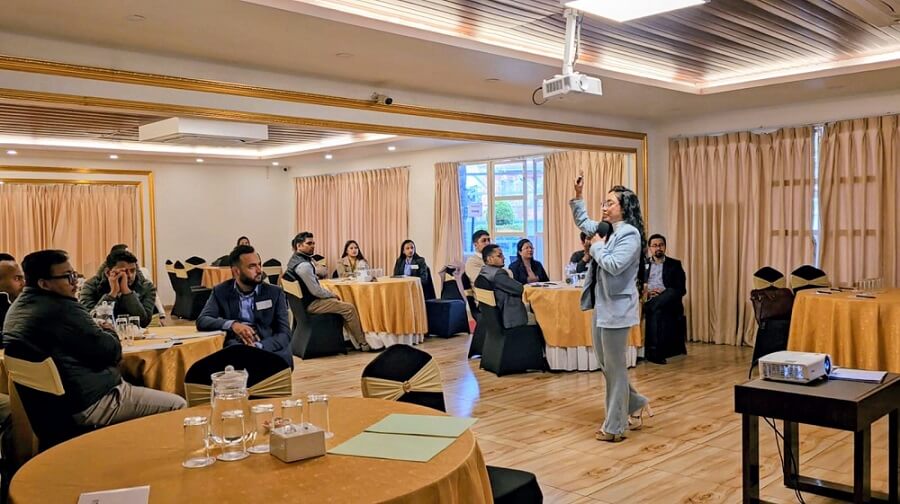
One of the defining features of Pooja’s career is the variety of environments she has had to understand: development-sector retreats, universities, government institutions, banks, hospitals, manufacturing companies, frontline service teams, leadership workshops, career counselling sessions, and senior stakeholder meetings.
Each setting requires a different kind of conversation.
Over the years, Pooja’s training and facilitation experience has included engagements with organizations such as UNDP Nepal, Welthungerhilfe Nepal, FAO Nepal, Habitat for Humanity International Nepal, WWF Nepal, UNICEF Nepal, GIZ Nepal, Swisscontact, Save the Children, USAID Karnali Water Activity, The Leprosy Mission Nepal, Handicap International Nepal, and United Nations traineeship programs, among others.
The subjects have ranged from leadership, team effectiveness, communication, public speaking, professional etiquette, employability, Training of Trainers, and career development to Monitoring, Evaluation, Accountability and Learning.
The diversity of these assignments taught her that the same training cannot simply be copied from one organization to another.
A development-sector manager, frontline service employee, manufacturing team, and newly promoted manager face very different realities.
The context changes, so the learning must change with it.
This is why Pooja’s facilitation style is built around practical application. Role plays, workplace scenarios, reflection, peer learning, structured activities, and coaching conversations are not used simply to make a workshop engaging.
They are used to help participants practice the behaviors they will need outside the room.
When Training Became Organizational Development
As Pooja’s career evolved, her work expanded into deeper organizational consulting.
At St. Xavier’s College, her responsibilities have included Training Needs Assessment, Learning and Development frameworks, competency standards, performance management guidelines, KPI development, appraisal systems, development planning, and long-term training roadmaps.
As Training Head for VFS Global in Nepal, she has worked across induction, professional communication, client handling, customer service excellence, learning assessment, behavioral observation, individual coaching, and training effectiveness.
Her professional development and career counselling work with the British Embassy Kathmandu and UK has included CV enhancement, interview preparation, role-specific mock interviews, one-to-one career counselling, and strategic career planning for professionals from varied backgrounds.
As National HR Consultant for Nepal Red Cross Society in collaboration with IFRC, her work has involved another level of organizational complexity: reviewing HR policies and service rules, examining staffing and grading systems, assessing contractual modalities and workforce composition, conducting stakeholder consultations, and contributing to organizational reform priorities.
She has also contributed to curriculum development work with Kathmandu University, institutional and workforce review, and participatory research related to the economic and livelihood experiences of persons with disabilities affected by climate-related challenges.
Together, these experiences have moved her far beyond the conventional image of a trainer standing in front of a room.
Today, Pooja works across the wider question of how organizations build the capability to perform.
From One-Day Workshops to Learning Systems
Perhaps the clearest evidence of this evolution can be seen in the longer Learning and Development interventions highlighted in her recent work.
For a hospitality business in India, PS Learning Lounge worked on a structured intervention designed to make training more consistent, standardized, and accessible. The work included LMS development, curriculum design, training plans, short learning videos, staff assessments, and structured learning pathways.
The documented outcomes included faster onboarding, improved access to learning content, higher assessment completion, fewer repeated explanations, better visibility of staff progress, and stronger service consistency.
More importantly, the intervention addressed a common problem: when learning depends on who happens to explain something on a particular day, quality becomes inconsistent.
The system becomes part of the solution.
A six-month Learning and Development intervention for a food manufacturing company in India followed a similar principle. The work focused on role-wise learning gaps, curriculum development, LMS-based learning, practical assessments, structured pathways, and repeatable workplace performance.
Her wider portfolio also includes long-term interventions in service and pharmaceutical environments focused on learning systems, staff capability, consistency, and workplace application.
This reflects a major shift in her professional journey.
The question is no longer only:
“How do we deliver a good training session?”
It is:
“How do we build an environment where learning continues and performance becomes more consistent?”
The Philosophy Behind Her Work
Pooja’s professional philosophy can be understood through a few ideas that recur across both her consulting work and her public writing.
The first is that learning should solve a real problem.
She does not begin with a topic simply because it is popular. Her approach begins with understanding the business challenge, identifying the capability gap, and designing something that people can apply.
The second is that leadership is experienced through behavior.
Pooja often writes about the difficult transition from individual performer to manager. The skills that earn someone a promotion are not always the skills required to lead a team.
Execution must give way to delegation.
Personal expertise must expand into developing others.
Doing the work must become enabling other people to do their best work.
This is why she sees leadership development as more than teaching models or theories. Leaders influence whether people speak up, whether mistakes become learning opportunities, whether accountability feels fair, whether trust grows, and whether capable employees believe there is room for them to develop.
In her view, culture is not created primarily by values written on a wall. It is created through the leadership behaviors people experience every day.
A third theme is communication.
Pooja has repeatedly observed that many workplace problems are not caused by a lack of intelligence or technical skill. They are caused by misunderstandings, unclear expectations, poor feedback, avoided conversations, and weak collaboration.
Projects are delayed, feedback becomes defensive, good ideas remain unspoken, and capable people can still struggle to work together.
For her, communication is not a “soft” addition to serious performance.
It is one of the mechanisms through which performance happens.
A fourth theme is opportunity.
Across her work in employability, inclusion, career development, and leadership, Pooja has returned to the idea that people often have more potential than they are currently able to demonstrate.
Sometimes confidence comes before opportunity.
But sometimes opportunity is what creates confidence.
That belief connects her early work with persons with disabilities to her current work with managers, teams, students, and professionals.
Different audiences. The same underlying question:
What becomes possible when people are given the right support, expectations, and opportunity to grow?
Impact Beyond Attendance
Pooja’s work has now reached more than 7,000 professionals across more than 100 organizations.
The importance of those numbers lies not only in scale, but in range. She has worked with frontline employees and senior leaders, students and professionals, government officials, development practitioners, career seekers, and institutional decision-makers.
That breadth has taught her to avoid easy assumptions.
The employee who appears unmotivated may lack clarity.
The manager who appears controlling may never have learned how to delegate.
The person who appears unready may simply need an opportunity and the right support.
Her client and participant feedback repeatedly highlights her ability to connect with diverse audiences, create active participation, use practical exercises and role plays, and align learning with organizational context. Organizations and professionals who have worked with her have described her approach as engaging, collaborative, practical, and closely connected to the needs of the people in the room.
Her work has also extended into research and publication. She has published on training design and participant learning, performance appraisal and employee motivation, workplace productivity, and motivational factors affecting employee performance.
These subjects closely mirror the questions she encounters in practice.
What makes learning effective?
How do systems influence motivation?
Why do some workplaces help people contribute more than others?
How should organizations connect development with performance?
Her research gives her frameworks.
Her professional practice gives those frameworks reality.
Building a Voice Beyond the Training Room
Pooja’s impact also extends into public knowledge-sharing.
Through LinkedIn, she has built a professional community of more than 34,000 followers, where she shares practical perspectives on leadership, workplace communication, employee engagement, learning culture, career development, customer experience, and organizational performance.
Her content returns to the questions she addresses inside organizations: why new managers struggle after promotion, what happens when good employees stop speaking up, why training fails to create behavior change, and what makes people trust leaders.
The platform has become an extension of her professional practice, translating workplace lessons into accessible ideas for a wider audience.
The Person Behind the Professional
Pooja’s work is highly structured, but the qualities most visible in the way she works are human.
Client feedback repeatedly describes her as engaging, collaborative, enthusiastic, professional, and able to connect with different audiences. Her sessions are often noted for active participation, practical exercises, thoughtful structure, and an ability to align with an organization’s culture rather than impose a generic format.
That working style helps explain why her career has crossed so many professional boundaries.
She can move from a conversation about HR policy to a coaching discussion about confidence.
From a leadership retreat to a curriculum-development meeting.
From a customer-service role play to a senior stakeholder consultation.
The setting changes, but the working principle remains consistent:
Listen carefully enough to understand what is really happening before deciding what should happen next.
The Future: Building Learning That Lasts
The future Pooja is building through PS Learning Lounge is not centered on delivering the largest possible number of workshops.
It is centered on creating stronger learning ecosystems.
With operating offices in Nepal and India and work extending into international professional contexts, the direction is toward deeper, more structured interventions: leadership pathways, learning systems, curricula, capability frameworks, organizational diagnostics, HR systems, executive facilitation, coaching, and sustained behavior change.
The ambition is not simply to help people know more.
It is to help organizations become better at developing people.
That means moving from isolated workshops to learning journeys, from generic training calendars to diagnosed needs, from participant satisfaction to workplace application, and from individual effort to systems that make good performance easier to repeat.
For Pooja, this is where the future of Learning and Development becomes most meaningful.
Her Golden Advice for Someone Starting from Scratch
If someone were starting from scratch in training, HR consulting, leadership development, or Learning and Development, Pooja’s journey points to one practical piece of advice:
Do not rush to become the person with all the answers. Become the person who learns to understand the problem.
Study the theory, but spend time in real workplaces.
Learn facilitation, but also learn to listen.
Do not assume every performance problem requires training.
Understand people and systems.
Observe what happens after the workshop and ask whether behavior changed.
Build credibility through usefulness, not complexity, and remain willing to adapt.
Pooja’s own career has moved through HR, development work, disability inclusion, employability, project management, training, curriculum design, consulting, leadership development, organizational systems, research, public knowledge-sharing, and entrepreneurship.
The path has been valuable not because every stage looked the same, but because every stage added another way of understanding people at work.
The Work That Begins After the Session Ends
Pooja Dangol’s journey can be measured in qualifications, assignments, organizations, countries, programs, publications, and thousands of professionals reached.
But the clearest way to understand her work is simpler.
She is interested in what happens next: after the workshop, the promotion, the policy, the feedback, and the moment an employee says they understand.
Does the manager lead differently?
Does the team communicate better?
Does the employee feel more capable?
Does the organization create a system that helps good behavior continue?
That is the space in which Pooja has built her career.
From her early work in inclusive employment to organizational consulting, leadership development, long-term learning interventions, research, international expansion, and the growth of PS Learning Lounge, the scale of her work has changed considerably.
The central question has not.
How do we help people and organizations turn learning into better performance?
For Pooja Dangol, the answer is not found in a single training room.
It is found in the systems organizations build, the behaviors leaders repeat, the conversations teams are willing to have, and the opportunities people are given to grow.
And that is why, in her work, the end of a training session is rarely the end of the story.
It is where the real work begins.