The Search Engine Has Left the Building
Something fundamental has shifted in the way people find information online — and most businesses haven’t caught up yet.
For over two decades, the game of digital marketing was clear: rank high on Google, attract clicks, drive traffic to your website, convert visitors into customers. It was a linear, measurable machine. But that machine is breaking down.
Today, a growing proportion of searches end before a single click ever happens. Users type a question into Google, get a direct answer at the top of the page, and move on — never visiting any of the websites that powered that answer. This is the zero-click search phenomenon, and it is quietly dismantling the foundations of traditional SEO and content marketing.
The numbers are stark. According to Semrush data, 58.5% of U.S. searches and 59.7% of EU searches ended without a click in 2024.
Bain & Company’s research, based on a December 2024 survey of over 1,100 consumers, found that roughly 80% of search users now rely on zero-click results in at least 40% of their searches — reducing estimated organic web traffic by 15% to 25%.
This isn’t a rounding error. It’s a structural transformation of the internet.
What Is a Zero-Click Search?
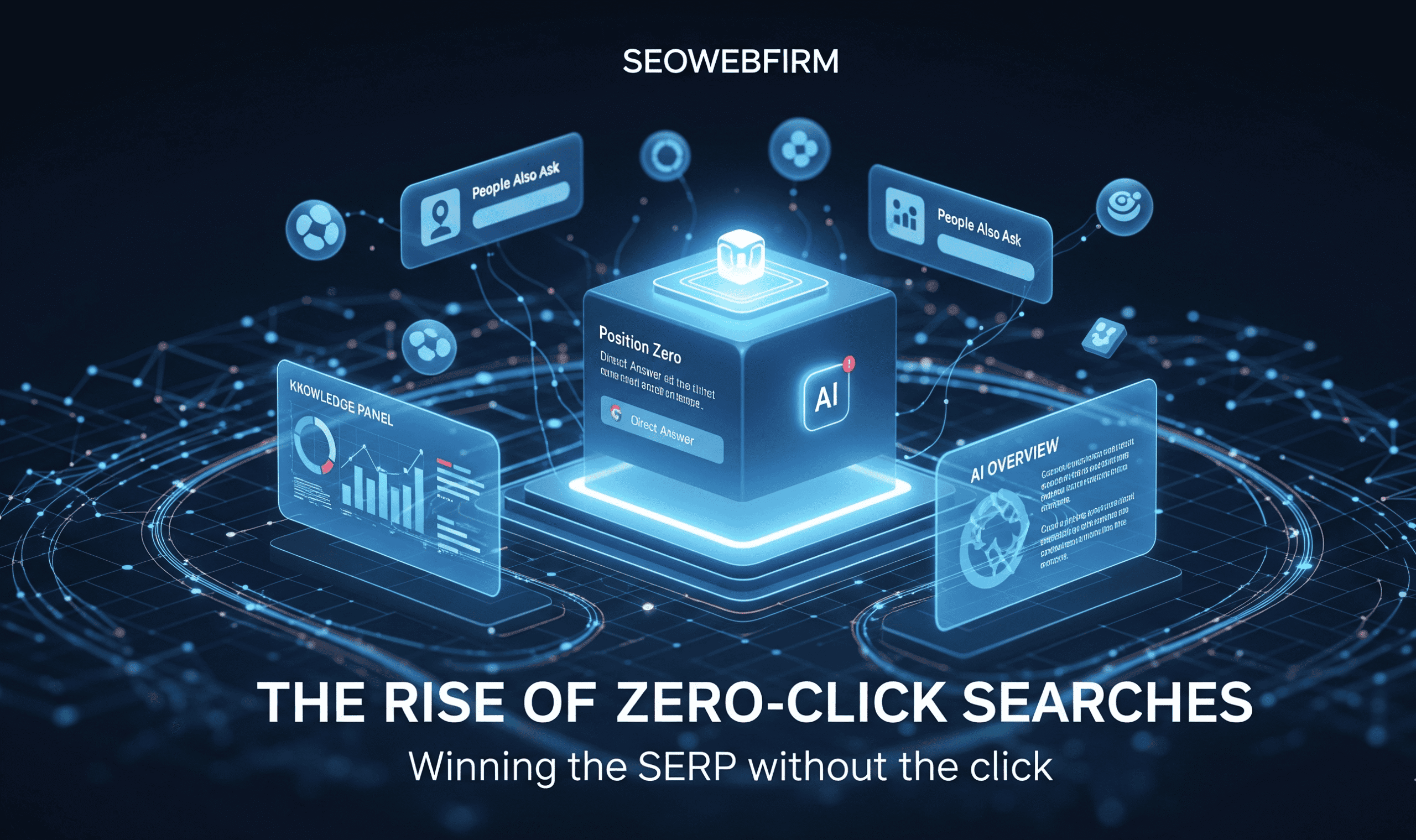
A zero-click search occurs when a user’s query is resolved directly on the search engine results page (SERP), with no need to click through to any external website. The answer is surfaced right there — in a featured snippet, a knowledge panel, a local map pack, a People Also Ask (PAA) box, or increasingly, an AI-generated overview.
Search engines have always had the ambition to answer questions, not just index websites. What has changed is their capability. With the arrival of AI Overviews, Google has made an evolutionary leap from simple text extraction to intelligent synthesis — blending information from dozens of sources into a single, cohesive, conversational response. Users get their answer. Your website gets bypassed.
The Anatomy of Zero-Click Features
Understanding which SERP features drive zero-click behavior is the first step to adapting your strategy.
Featured Snippets — The Pioneer
Featured snippets were the original zero-click format, appearing above all organic results in what SEOs called “Position Zero.” They trained an entire generation of searchers to expect instant answers. Whether a definition box, a numbered how-to list, or a comparison table, featured snippets normalized the idea of getting information without leaving Google.
They also created a hidden cost: when featured snippets feed voice assistants like Alexa or Google Home, your content becomes the spoken answer — with no attribution, no brand mention, no clickthrough. Your words speak, but no one knows they’re yours.
AI Overviews — The Game Changer
AI Overviews represent the biggest disruption to search since mobile overtook desktop. Unlike featured snippets, which pull verbatim text from a single website, AI Overviews synthesize insights from multiple sources into a coherent, nuanced response. According to Semrush data, AI Overviews were triggered for 13.14% of queries in March 2025 — nearly double the 6.49% rate seen just two months earlier in January 2025. The trajectory is steep.
The visibility paradox is striking. One Search Engine Land analysis showed that in the year following Google AI Overviews going live, a website’s impressions more than doubled while its click-through rate collapsed from approximately 1.5% to under 0.5%. More people saw the content. Fewer of them ever arrived at the website.
People Also Ask — The Rabbit Hole
People Also Ask boxes appear in approximately 78% of search results, making them one of the most pervasive zero-click features on the web. They function as an expandable question-and-answer system, with each answer pulling from a ranked website — and each click within the box expanding more questions rather than sending the user anywhere else.
Local Packs — The Local Business Disruptor
For location-based searches, Google’s local three-pack delivers maps, business hours, reviews, and phone numbers — all without the user visiting any individual business website. For service businesses, this has effectively replaced website traffic as the primary digital acquisition channel. The businesses that master their Google Business Profile, maintain consistent NAP (Name, Address, Phone) data, and build review volume own their local market’s digital front door.
Knowledge Panels
When users search for well-known people, brands, organizations, or concepts, Google often displays a knowledge panel — a curated information card pulled from its Knowledge Graph. These panels answer the user’s underlying need instantly, particularly for navigational and informational queries.
Why This Is Accelerating: The AI Search Revolution
Two tectonic forces are compounding the zero-click trend simultaneously.
The first is the evolution of traditional search engines. Google and Bing are both aggressively integrating generative AI into their results pages, building systems that synthesize and present knowledge rather than simply organizing links to it.
The second is the emergence of entirely new search paradigms. Platforms like ChatGPT and Perplexity AI are capturing search intent that used to belong exclusively to Google.
Bain’s research found that ChatGPT saw 44% traffic growth in November 2024 alone, while Perplexity reached 15 million monthly active users by late 2024.
Among LLM users, 68% use these platforms to conduct research and summarize information, 48% use them for news and weather, and 42% use them for shopping recommendations.
These platforms don’t link to your website. They absorb your content, synthesize it, and present a packaged answer to the user. The era of search as a traffic delivery mechanism is ending. The era of search as an answer delivery mechanism is here.
The Marketing Implications Are Enormous
For marketers, this shift creates an urgent strategic dilemma. The entire playbook of the last two decades — rank, attract, click, convert — is being undermined by a system that answers queries before users ever reach the conversion funnel.
Bain’s research frames the problem sharply: as organic clickthrough rates fall, brands are losing share of voice in high-value, non-branded searches — the discovery phase where customers seek answers and opinions before committing to any specific brand. These are the moments where new relationships begin. When an AI summary answers the user’s question for them, your brand may not enter that conversation at all.
The customer journey, which was already non-linear, is becoming increasingly algorithm-driven. Generative AI doesn’t just disrupt traffic — it constructs its own narrative about your industry, and your brand may or may not feature in that narrative depending on how well you’ve optimized for the AI era.
Rethinking Success: From Traffic to Visibility
The hardest part of adapting to zero-click search is not tactical — it is psychological. It requires marketers and SEO professionals to let go of click volume as the primary measure of success and embrace a broader, more nuanced definition of visibility.
This is not as abstract as it sounds. The data suggests that users who do click through from AI search are demonstrably higher-quality leads: they’ve already seen a summary, understood the context, and chosen to go deeper. Traffic volume falls, but conversion rates can improve.
The new metrics that matter in a zero-click world include:
AI Visibility Score — how often your brand appears in AI-generated answers across Google, ChatGPT, Perplexity, and other platforms.
SERP Feature Share — your percentage of featured snippets, PAA boxes, and knowledge panel appearances for target keywords.
Brand Mention Sentiment — not just how often your brand appears in AI responses, but the quality and framing of those mentions.
Answer Inclusion Rate — the proportion of AI-generated responses in your category that reference your brand when users ask relevant questions.
Question Coverage Rate — the percentage of audience questions your content addresses across SERP features, signaling topical authority.
These visibility metrics exist alongside traditional conversion tracking — and the most sophisticated teams are now measuring both in tandem, demonstrating to stakeholders that SERP presence drives downstream business outcomes even when it cannot be traced through a direct click.
How to Win in a Zero-Click World
Adapting to zero-click search is not about abandoning SEO. It is about evolving from traffic optimization to visibility optimization — and doing so with strategic precision.
-
Format Content for AI Extraction
The content that gets cited in AI Overviews, featured snippets, and voice search responses shares common structural characteristics. Write in short, standalone paragraphs of 40–60 words that answer the query in the opening sentence, then elaborate. Use clear definitions that begin with “X is…” Use numbered or bulleted lists for how-to content. Structure comparison tables for competitive queries. Match your headings to the exact phrasing of common search queries.
This isn’t about dumbing down your content — it’s about making your expertise immediately accessible to machines that decide what gets surfaced.
-
Implement Schema Markup Strategically
Schema markup (structured data) helps both traditional search engines and LLMs understand and categorize your content. FAQPage schema improves your chances of appearing in People Also Ask boxes and AI Overviews. HowTo schema increases visibility in step-by-step rich results. LocalBusiness schema populates knowledge panels and local pack data.
These are foundational technical investments that signal to AI systems exactly what type of content you’re providing and who it serves.
-
Build Topical Authority, Not Just Keyword Rankings
AI systems don’t just evaluate individual pages — they assess the depth and coherence of your entire body of content on a topic. The brands that get cited most in AI responses are those that demonstrate comprehensive expertise across a topic cluster, not those that rank for isolated keywords.
Build interconnected content ecosystems. Answer every relevant question within a topic area. Update cornerstone content quarterly with fresh data and evolved perspectives. Demonstrate E-E-A-T (Experience, Expertise, Authoritativeness, and Trustworthiness) through original research, expert quotes, and real-world case studies that cannot be found elsewhere.
First-party data is especially powerful. Original surveys, proprietary studies, and data sourced from your own customer base create content that AI systems cannot synthesize from other sources — making your work uniquely citable.
-
Optimize for Entity Recognition
In Google’s Knowledge Graph model, entities — brands, people, places, concepts — have defined attributes and relationships. Content that explicitly establishes and connects these relationships is better understood by AI systems and more likely to appear in knowledge panels and AI-generated responses.
Cross-link your own content to establish topical relationships. Use author schema to connect your content to named experts. Embed YouTube videos, podcasts, and infographics that connect to your written content. Maintain consistent, accurate information about your brand across all digital properties — your website, social profiles, directories, and third-party review platforms.
-
Optimize for Voice and Conversational Queries
Voice search has rewired the nature of queries. People don’t speak in keywords — they ask full, natural questions. Your content needs to anticipate and match this conversational register.
Write at an accessible reading level. Use simple sentence structures. Structure content to flow naturally from one sub-question to the next, anticipating the follow-up queries users will ask. Read your content aloud — if it sounds robotic or stilted, it will sound the same when delivered by a voice assistant.
Local voice queries in particular carry high intent. Structuring your content to include conversational phrases like “Where can I find…” and “Who offers…” can position your business for voice citation.
-
Diversify Beyond Google
Perhaps the most important strategic shift is recognizing that “search” no longer means only Google. Optimize for AI crawlability across the full ecosystem — ensure your content is accessible and well-structured for ChatGPT, Perplexity, Bing Copilot, and whatever platforms emerge next. Avoid gating high-value content behind forms or PDFs that AI systems cannot readily access.
Consider a broader brand presence strategy that includes PR, social media, community engagement, and email — channels that build brand recognition independently of search traffic and that create multiple touchpoints with potential customers who may never arrive via a search click.
The Opportunity Hidden in Plain Sight
Zero-click search is not only a threat — it is an opportunity for the brands willing to embrace it.
Every appearance in an AI Overview, every featured snippet, every knowledge panel citation is a moment of brand exposure at the precise moment a consumer is actively seeking information in your category. These are not wasted impressions. They are, as Semrush’s research framing suggests, the equivalent of a precisely targeted billboard — but one that appears in response to demonstrated intent rather than a demographic guess.
The brands that will win the next decade of digital marketing are not those that mourn lost traffic. They are those that redefine what winning looks like — measuring visibility, authority, and brand trust alongside direct conversions, and building content strategies sophisticated enough to earn presence at every stage of the AI-mediated customer journey.
Zero-click searches are not the end of the web. They are the beginning of a new kind of digital presence — one where what you say matters more than where you say it, and where being the definitive voice in your category is worth more than any single click ever was.